

Lesion (MS lesion)
An MS lesion is an area of damage or scarring in the brain or spinal cord. Lesions are caused by inflammation that results from the immune system attacking the myelin sheath around the nerves in your central nervous system.
Nerve cells carry messages between the central nervous system and the organs and limbs of the body. In multiple sclerosis (MS), nerve cells or neurons are damaged by inflammation and demyelination can occur.
Multiple sclerosis is thought to be partly an autoimmune and partly a neurodegenerative condition. For some reason, the body's immune system starts to mistakenly attack cells within the central nervous system. Initially the body can repair the damage to some extent, but with time nerve cells may begin to die. Scars develop on the damaged nerves. This scar tissue is what forms the lesions that show up as white regions on MRI scans.
Although other cells die and are replaced, many neurons are never replaced when they die. If you lose too many neurons, you may develop permanent disability. The disability you experience relates to the neurons which are damaged. For example, if you lose some of the neurons in your spine, your legs could be affected, leading to problems with walking.
Neurons have specialised extensions called dendrites and axons. A neuron usually has a number of dendrites but only one axon, although this axon may have extensive branching. The axon can be as long as one metre, making neurons some of the longest cells in the body.
Information enters the neuron via the dendrites, passes through the cell body and then along the axon until it reaches the synapse. The synapse is the space between an axon and a dendrite of another neuron.
To cross the synapse, neurotransmitters are released at the end of the neuron. They are collected by receptors on the dendrites of neighbouring neurons, and the message continues on its way.
The axon is surrounded by a sheath of fatty protein called myelin. Myelin acts as insulation to the axon and prevents messages becoming interrupted. The myelin sheath has short gaps about one micrometre apart known as Nodes of Ranvier. Nerve messages leap along the axon from node to node. The thickness of the myelin sheath and the size of the gap between nodes determine the speed of messages, which can be as fast as 120 metres/second (268mph).
Nerve cells are surrounded by support cells called glial cells. They include oligodendrocytes which produce myelin.
During an MS attack, the immune system triggers inflammation along the nerves and at the glial cells. Oligodendrocytes are damaged, and myelin is damaged and stripped away from the axon. This process is called demyelination. Messages that pass along a demyelinated nerve become delayed or blocked.
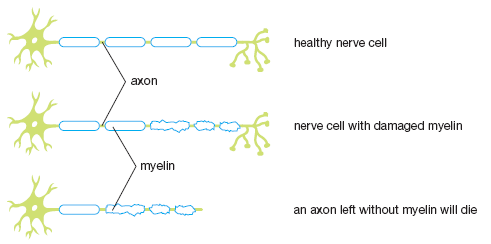
As the central nervous system controls processes throughout the body, a wide range of symptoms can occur, depending on where the nerve damage has happened. The range of symptoms is different for each person with MS.
Once the inflammation caused by the immune attack is over, it is possible for the body to replace damaged myelin. This process is known as remyelination. Although the new myelin can work effectively, it tends to be thinner than unaffected myelin and so messages through the affected nerves may not be as fast as before the attack.
Remyelination tends to occur in the earlier stages of MS but, with repeated relapses or attacks, oligodendrocytes become damaged and destroyed. Eventually, they may not be able to produce more myelin. If an axon is left without the protection of myelin it will be more vulnerable to damage and may die.
Your central nervous system is able to overcome small areas of nerve damage by rerouting messages using undamaged nerve cells. This ability to adapt to avoid damaged areas is called plasticity. Messages may take longer to get through but your symptoms will improve to some extent.
Should the area of damage become too large, this rerouting process is no longer able to compensate. Messages to or from that part of the central nervous system are permanently blocked, resulting in symptoms that do not improve for you.
Remyelination and neuroprotection are potential areas where new treatments could be developed. Some research is looking into drugs that protect nerves from damage and so halt or slow down the progression of MS. Some research is investigating drugs that promote myelin repair, which would mean that damage could be reversed and function improved.
Read more about what happens to the nervous system in MS in these other webpages in our A-Z.
We are here to support you. You may have MS yourself or be a friend or family member of someone with the condition.
Our experienced Helpline team are here to help you find all the information you need about multiple sclerosis. We'll try to answer any question that you have about MS and if we can't find the answer, we can direct you to someone who can.
You can call free on 0800 032 38 39 or email us at helpline@mstrust.org.uk
We're open Monday to Friday (except bank holidays) from 10am-4pm. Outside these hours, you can leave us a message and we'll get back to you as soon as we can.

